How to Choose a Scent for a Small Apartment
A small apartment can turn a pleasant fragrance into a heavy cloud fast. The right scent feels polished but stays in the background, even when your living room also serves as your office and bedroom. Here's how to choose a scent for a minimalist small apartment, then match it with a low-clutter diffuser and a setting you can live with.
Step 1: Match the Scent Profile to Your Apartment’s Mood
Start with the room’s mood and air volume before you pick a fragrance family. In a small apartment, light citrus, tea, clean musk, sheer florals, and soft woods usually behave better than dense vanilla, oud, resin, or syrupy gourmand notes.
Look at the room as a whole. White walls, pale wood, linen, and open shelves often pair well with bright or airy scents. Dark wood, warm lamps, and layered fabrics can handle a gentle wood or soft amber blend, but keep the output low.
The first burst can fool you. A fragrance may smell light for ten minutes, then grow dense as its base notes settle into curtains, cushions, and clothing. Test the drydown at arm’s length. That is closer to how the scent will feel during a full evening at home.
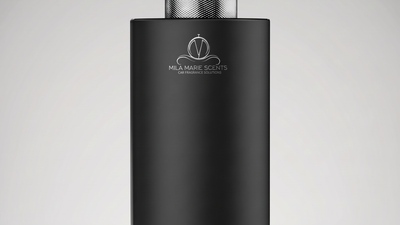
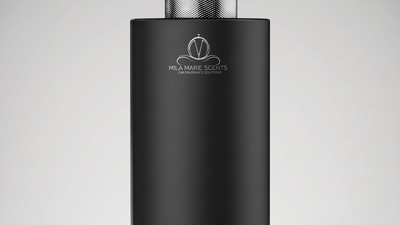
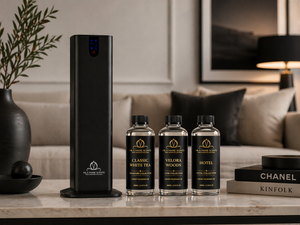
For a clean, hotel-style direction, Mila Marie Scents has oils such as Classic White Tea and Citrus Bloom. Velora Woods gives you a different direction when your room needs more warmth. Treat these as scent profiles to test, not automatic matches.
Write three words that describe the apartment at its best. Try “bright, quiet, airy” for a calm studio. “Warm, clean, grounded” may suit a larger open plan with wood and textured fabric. Those words become your filter when a fragrance description sounds attractive but does not fit the room.
If you want a longer mood exercise, define the feeling first, then choose the note family. You can use this home scent exercise as a prompt.
- For a work zone:Try tea, citrus, iris, or a clean wood.
- For a sleeping zone:Choose a soft floral or restrained musk.
- For an entry and living zone:Use a fresh blend with enough shape to welcome guests.
- For a scent-sensitive home:Choose the lightest format, or skip fragrance altogether.
Keep the bottle and oil storage out of direct sun, steam, and heat. A drawer or closed shelf protects the fragrance and reduces visual clutter. When a bottle sits in plain view, you may use it more often than the room needs.
Also think about shared air. A fragrance that feels refined beside your chair may feel intrusive beside a bed or desk. In a studio, courtesy matters because there is little distance between one person’s comfort and another person’s irritation.

Step 2: Choose the Right Scent Intensity for a Small Space
Use the lowest diffuser setting first, then raise it in small steps. A small apartment usually needs less scent than its square footage suggests because walls, fabric, and limited airflow hold aroma in place.
Coverage ratings can help, but they do not tell you how strong a room will feel, and a big number is not a recommendation. The only Mila Marie Scents unit rated to 16,000 square feet is the INFINITY, which is $399 and connects to existing HVAC ductwork — not a realistic option in a rented apartment, and far more system than one room needs. For a small apartment the relevant figures are the ECHO Mini at up to 700 square feet and the Elite Mini Pro at up to 1,800.
Intensity and coverage are separate decisions. Coverage asks where the scent can travel. Intensity asks how much scent enters the air. For a 400-square-foot studio, start low even if the diffuser can cover much more space.
Cold-air diffusion is useful when you want a heat-free setup. The method disperses fragrance without a water reservoir or open flame. The Mila Marie Scents units are waterless and heat-free, and they are described as low-noise. Only two of them carry a published figure — the Elite Mini Pro and the INFINITY are rated under 35 dB — so if a measured noise level is what you care about in a studio, the Elite Mini Pro is the one that gives you one. Those details matter in a small home, where a humming device or an oily surface becomes hard to ignore.
Indoor air quality also depends on indoor sources and ventilation. Keep this in mind when scenting a compact room. Do not use fragrance to cover smoke, damp, mold, or a stale air problem. Fix the source first.
Set a simple first-week test:
- Run the diffuser at its lowest setting.
- Use it for a short period while you are home.
- Leave the room for a few minutes.
- Return and judge the scent at the door.
- Ask someone else for a fresh opinion if possible.
Your own nose adapts quickly. This process is called olfactory fatigue, a reduced response after repeated exposure. This effect explains why a scent may seem to vanish to you while a guest notices it at once.
Do not turn up the diffuser just because you cannot smell it every minute. If you notice the fragrance when entering the room, that may be enough. If it sits on clothing or makes the room feel thick, reduce the setting or shorten the schedule.
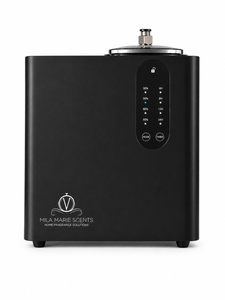
For bedroom and office use in an apartment, there are three sensible Mila Marie Scents models and they are all standalone. The ECHO Mini is $89 and rated to 700 square feet; it is cordless and runs on three D batteries, which are not included. The Elite Mini Pro is $99 and rated to 1,800 square feet; it is also cordless, with a built-in rechargeable battery and USB-C charging. The ECHO is $139, plugs in, and holds 200 ml. PULSE and INFINITY are built around HVAC ductwork, which most renters cannot touch, and Elite Car Pro is for a car. All three of the apartment options have Bluetooth app control.
Set different expectations for private and shared zones.
Step 3: Select a Low-Clutter Diffuser That Fits Your Floor Plan
Choose one diffuser that covers the main zone without adding another object to every surface. In a minimalist apartment, one well-placed cold-air diffuser usually makes more sense than several small plug-ins competing across the home.
Map the floor plan before you shop. Mark the entry, main seating area, bed, work desk, kitchen, and HVAC vents. Then note where air naturally moves. A central console or shelf near the main air path often works better than a corner behind a chair.
One fact does more to set expectations than any coverage rating: cold-air mist will not pass a closed door. Only the ducted units reach a closed room, and those are the ones a renter usually cannot install. This is why a studio scents easily from a single unit and a one-bedroom does not — shut the bedroom door and the bedroom is simply outside the diffuser's reach, whatever square footage the box claims. If you want scent in a closed bedroom, plan on a second unit in there rather than a bigger unit in the living room.
Do not put the diffuser right beside your pillow or under your nose at the desk. Place it in a central but discreet spot. A lower position can help scent move upward in a loft, while a mid-height shelf may work well in a flat studio.
Mila Marie Scents gives you several named models to compare, and for an apartment most of them can be ruled out quickly. ECHO Mini ($89, up to 700 sq ft) and Elite Mini Pro ($99, up to 1,800 sq ft) are the cordless options, which is what matters when your outlets are already spoken for. ECHO ($139, up to 1,500 sq ft, 200 ml reservoir) plugs in and sits on a shelf with no installation. PULSE ($149, up to 1,800 sq ft) is designed to connect to HVAC ductwork, though it can also run standalone in a large room. INFINITY ($399) is a ducted whole-home system. HALO Tower ($229) is a floor tower rated for up to 4,000 sq ft of open space, which is more than an apartment asks for. Elite Car Pro is for a car.
Look for the features that reduce daily fuss:
- Heat-free operation:This removes a flame and heating element from the setup.
- Waterless design:You do not need to fill and empty a water tank.
- Quiet output:Lower noise matters beside a bed or work desk.
- Timer control:Short cycles keep scent from running all day.
- Small footprint:The device should fit the furniture you already own.
Treat a coverage rating as a ceiling, not a command to run the diffuser at full power. These figures are manufacturer-stated and there is no shared industry testing standard behind them, so they are useful for ruling a unit out as too small and much less useful for predicting how a particular room will feel. One ECHO Mini will usually cover an open studio floor. It will not cover a one-bedroom with the door shut, no matter what the number says.
Oil choice affects the clutter problem too. Keep two or three oils rather than a shelf full of bottles. Classic White Tea can suit daytime use, while Cascade or Velora Woods may fit a quieter evening mood. Oils come in 120 ml, 200 ml and 500 ml — in a small apartment the smallest size is usually the sensible first buy, because opened oil cannot be returned. Change one variable at a time so you know what caused the room to feel better or worse.
Review the Mila Marie Scents diffuser system page when choosing a unit and oils.
Families with children or pets may also prefer a heat-free system because it removes an open flame from the room. Still, follow the product instructions and keep fragrance oils out of reach. Heat-free does not mean every oil is harmless if swallowed or spilled.
Skip HVAC scenting altogether if you rent. PULSE and INFINITY connect to ductwork, and that is a change to the building's system rather than to your furniture — not usually yours to make, and not worth the money for one apartment. A standalone unit is simpler, moves with you, and leaves the vents, the wiring and the lease alone.
Step 4: Test, Place, and Fine-Tune the Scent Before Committing
Test one fragrance in one room before you commit to a full home routine. Give the scent enough time to settle, then judge it at the entry, the sofa, the desk, and the bed.
Start with a short run at low intensity. Close the room for a while, then return after fresh air has moved through the space. Note four things: how quickly you smell it, where it feels strongest, whether it clings to fabric, and how you feel after an hour.
Use this quick decision table to separate a scent problem from a placement problem.
Placement should support gentle air movement. Opposite a door or near a natural circulation path may help the fragrance spread. Avoid a sealed cabinet, a cramped shelf, or a spot directly beside your face.
Minimalist scenting works best when the fragrance stays close to the room instead of becoming a trail through the entire building. If neighbors can smell it through a shared hall, reduce the output. Shared walls make restraint part of good apartment etiquette.
Keep a small test note on your phone or a paper card. Record the oil, setting, run time, placement, and room temperature. Change only one item during the next test. That turns a vague reaction into a useful decision.
For open-plan apartments, adjust output gradually across one large zone; the guide may offer related ideas.

Rotate by time of day only after one scent works on its own. A bright profile can mark the start of the day, while a soft wood may suit the evening. Keep the change gradual so the apartment still feels like one home.
Mixing fragrance oils can work, but it raises the chance of a muddy result. Test a small amount outside the diffuser first. Use one dominant profile and one quiet accent. Do not add several oils to the reservoir when you are still learning how the room behaves.
When a scent still feels wrong after placement and intensity changes, stop forcing it. Some rooms need a lighter oil. Others need no scent at all. A good choice leaves you comfortable after the novelty fades.
Frequently Asked Questions
What scent works best in a small apartment?
Fresh citrus, white tea, clean musk, sheer florals, and soft woods usually work best in a small apartment. These profiles tend to feel lighter than dense vanilla, oud, resin, or heavy gourmand notes. For how to choose a scent for a minimalist small apartment, start with the room’s mood and test the fragrance after its base notes settle.
What is a heat free cold air diffuser?
A heat free cold air diffuser releases fragrance without a flame or heating element. It typically uses air pressure to disperse fragrance oil without water. This format can suit apartments because it avoids a hot surface and often needs less daily handling than a water-based unit. Follow the maker’s safety and cleaning instructions.
Is a cold air diffuser better than a candle for an apartment?
A cold air diffuser may be better when you want scheduled scent without an open flame. A candle gives you a short, direct scent experience, while a diffuser can provide a lower background level over time. In a small apartment, the better choice depends on your desired control, safety routine, furniture layout, and tolerance for lingering scent.
How can I sample scents before buying a bottle?
The Scent Card Sample Pack is $15 and covers 15 scents. They are scent cards rather than bottled oil, so they will tell you which profiles you like and not how a fragrance behaves once it is diffused in your own room — useful for narrowing a shortlist, not a substitute for a trial run. Test a few on different days, because smelling several at once blurs your judgment. Opened oil cannot be returned, which is the reason to narrow the list first.
Can I mix and match fragrance oils?
You can mix and match fragrance oils across rooms, but use one oil at a time in each diffuser. Keep nearby rooms within the same scent family so the transition feels calm. If you want to blend oils, test the combination in a small amount first and avoid adding several strong profiles together.
How do I try before I buy home fragrance?
To try before you buy home fragrance, use samples or a small bottle and test it in the room where it will run. Start at low output, wait through the drydown, and ask someone who has not been in the room all day. This gives you a better read than judging the scent from the bottle alone.
Conclusion
Choose a light or medium scent profile, use one well-placed heat-free diffuser, and begin at the lowest workable setting. For an apartment, the honest shortlist is the cordless ECHO Mini at $89, the cordless Elite Mini Pro at $99, or the plug-in ECHO at $139 — not a ducted system. Pair it with one oil, Classic White Tea or Velora Woods being reasonable places to start, and remember that a closed door is a wall as far as cold-air mist is concerned. Test one oil for a full day before adding another.
Best-selling diffusers & fragrances for your home
Which Diffuser Is Right for You?
| Feature | INFINITY | HALO Tower |
|---|---|---|
| Price | $399.00 | $229.00 |
| Coverage | Up to 16,000 sq ft | Up to 4,000 sq ft |
| Type | HVAC / Whole-Home | Floor Standing |
| App Control | Yes (Bluetooth) | Yes (Bluetooth) |
| Free Oils Included | Yes (3 Oils) | Yes (3 Oils) |
| Warranty | 1-Year | 1-Year |
| Guarantee | 30-Day | 30-Day |
Swipe to compare →
Get 10% Off Your First Order
Join the Mila Marie family for early access to new fragrances, exclusive offers, and expert scenting tips.