How to Size a Diffuser System for Vaulted Ceiling Rooms
Vaulted ceilings are stunning, but they quietly sabotage most diffusers. Standard coverage ratings assume an 8-foot ceiling, so a unit rated for 700 sq ft can underperform badly in a room with a 14-foot peak. Follow these five steps and you'll have the right system dialed in before you buy a single bottle of fragrance oil.
Step 1: Measure Vault Height and Floor Area
Your goal here is two numbers: the floor area in square feet and the room volume in cubic feet. You need both because diffuser manufacturers publish coverage in square feet, but vaulted rooms hold far more air than that number assumes.
Start with the floor. Measure the length and width of the room and multiply them. A 20 × 18-foot living room gives you 360 sq ft of floor area. Simple.
The ceiling is trickier. A vaulted ceiling has a ridge at the top and slopes down on both sides. According to standard measurement practice for vaulted ceilings, you calculate the triangular volume using the formula: ½ × length × width × height, where height is the vertical distance from the top of the wall to the peak. So if your room is 20 feet long, 20 feet wide, and the vault rises 8 feet above the wall plate, the volume of just the vaulted section is ½ × 20 × 20 × 8 = 1,600 cubic feet. Add that to the rectangular volume below the wall plate to obtain the total room volume.
Write both numbers down. You'll use the square footage to match a diffuser's coverage rating and the cubic footage to check whether the airflow is actually sufficient.
By the end of this step you should have: floor area (sq ft), wall-plate height (ft), peak height (ft), and total room volume (cubic ft). Keep these in a note on your phone. Every sizing decision from here flows from them.
Step 2: Calculate Required Airflow (CFM) for the Volume
CFM stands for cubic feet per minute. It tells you how quickly a diffuser can push scented air through a space. For vaulted rooms, this number matters more than the square-footage rating on the box, because you're filling a much larger air column than the manufacturer tested against.
A usable rule for residential scenting: you want to turn over the room's air volume roughly once every 20 to 30 minutes. Divide your cubic footage by 25 (a midpoint) to get a target CFM. For a typical large vaulted room, dividing the volume by 25 yields the target CFM.

Here's the catch: almost no consumer diffuser publishes a CFM rating. Our research confirmed that across ten diffusers from multiple sources, not a single one listed max ceiling height, airflow in CFM, or recommended room volume. Manufacturers publish square-footage coverage only, and that figure assumes a standard 8-foot ceiling.
So how do you use CFM when the spec isn't published? Two ways. First, contact the vendor directly and ask for airflow data. A good brand will have it. Second, use the square-footage rating as a proxy and apply a ceiling-height multiplier. The standard multiplier is: actual average ceiling height ÷ 8. For a room with a 12-foot average ceiling height, that's 12 ÷ 8 = 1.5. Multiply the diffuser's rated coverage by that factor to get its effective coverage in your room. A unit rated for 700 sq ft drops to roughly 467 effective sq ft in that space.
For more precise calculation on larger HVAC‑integrated systems, industry guidelines provide room‑type noise criteria and airflow guidance that HVAC engineers use when sizing commercial diffuser grilles.
By now you should have a target effective coverage number adjusted for your ceiling height. That's the figure you'll match to a diffuser's rated area in the next step.
Step 3: Select the Right Cold‑Air Diffuser
With your adjusted coverage number in hand, you can match it to a real product. Cold-air diffusion is the right technology for vaulted rooms. Heat-based methods push warm mist upward, where it dissipates near the ceiling and never reaches nose level. Cold-air units disperse fragrance oil as a dry, micro-fine mist at ambient temperature, so it travels with the room's natural air circulation rather than fighting it.
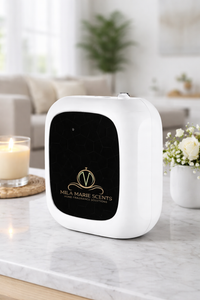
Our top pick for vaulted rooms up to 700 sq ft (adjusted floor area) is the ECHO Mini cold-air diffuser from Mila Marie Scents. It's the only unit in our research explicitly flagged as ideal for very high ceilings. It's heat-free, waterless, and pairs with Mila Marie Scents' curated fragrance oils like White Tea and Velora Woods for a hotel-level scent experience at home. No hot spots, no residue, no guesswork on ceiling compatibility.
For larger vaulted spaces, here's how the options stack up:
One honest caveat: the FYNTRA U4 and Aromadd U2 have strong coverage ratings but publish no ceiling-height data. If your vault exceeds 14 feet, apply the ceiling-height multiplier from Step 2 before assuming those ratings hold. The guide to the best diffusers for large rooms covers tank size and mist output in more detail if you're weighing those factors alongside coverage.
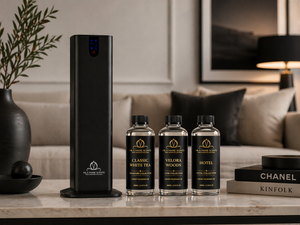
If your adjusted coverage need falls between 700 and 4,000 sq ft, the Halo Tower luxury floor diffuser from Mila Marie Scents is the natural step up. It's engineered for up to 4,000 sq ft with adjustable intensity, so you can dial it back for a smaller vaulted bedroom or open it up for a double-height great room.
Step 4: Adjust for Ceiling Shape and Obstructions
A clean calculation gets you close, but the physical room will throw curveballs. Ceiling shape, air movement, and structural features all change how scent actually travels, and vaulted rooms have more of these variables than flat-ceiling spaces.

Ceiling fans are the biggest wildcard. Research on diffuser performance in high-ceiling rooms shows that a fan running at high speed scatters mist randomly and pushes fragrance toward walls and corners rather than the breathing zone. The fix is simple: run the fan at low speed, or turn it off for the first 10 to 15 minutes after switching the diffuser on. That gives the cold-air mist time to settle at nose level before the fan redistributes it gently.
Structural obstructions matter too. Exposed wooden beams are common in vaulted rooms, and they trap mist particles. Textured ceiling finishes do the same thing. Both reduce how evenly fragrance spreads. If your room has heavy beam work, plan for a slightly more powerful unit or a second diffuser positioned on the opposite side of the room.
AC vents and return-air grilles pull mist upward, especially in rooms where the HVAC runs continuously. Place the diffuser away from direct vent paths. Waist height is the right position: high enough to let the mist disperse freely, low enough that it doesn't immediately get drawn into the ceiling air column. Avoid floor placement in vaulted rooms entirely.
Windows set high near the ridge are another scent drain. When they're open, warm air escapes through the top of the room and pulls fragrance with it. In summer, diffuse with high windows closed, or run the diffuser in short timed bursts rather than continuously.
For very long rectangular vaulted rooms, one unit rarely covers the full length evenly. Divide the room into scent zones and treat each zone as its own sizing problem. Two smaller diffusers placed at opposite ends often outperform one large unit centered in the middle. The comparison of HVAC scent diffusers for large homes explains how HVAC-integrated systems handle multi-zone coverage if that route makes sense for your space.
Step 5: Test, Fine‑Tune, and Maintain
Once the diffuser is placed and running, your sizing work isn't done. The first week is a calibration period. You're checking whether the scent reaches the main seating area at a noticeable but not overpowering level, and whether it lingers for a reasonable time after the unit cycles off.
Run the diffuser at its lowest intensity setting first. Vaulted rooms can feel like they need more fragrance, so people overcorrect and end up with an overwhelming concentration near the unit itself while the far corners stay faint. Start low, wait 20 minutes, then walk the room and note where the scent is strong, where it's faint, and where it's absent.
If the far end of the room is consistently weak, you have two options. First, increase the diffuser's output intensity by one step and test again. Second, reposition the unit closer to the center of the room's length. Don't jump to buying a second unit until you've tried both adjustments.
Fragrance oil choice also affects performance in tall spaces. Heavier base notes like sandalwood, vetiver, and cedarwood settle lower in the air column. Lighter top notes like citrus and eucalyptus rise faster and dissipate sooner in a vaulted room. Mila Marie Scents' Velora Woods blend leans on those grounding base notes, which makes it a usable choice for rooms where the air column is tall. White Tea is a lighter profile, better suited to vaulted spaces with good air circulation that keeps the mist moving.
Maintenance is straightforward for cold-air, waterless units. Wipe the nozzle weekly with a dry cloth to prevent oil buildup. Every two to four weeks, run a short cleaning cycle with the manufacturer's recommended cleaning solution or isopropyl alcohol. A clogged nozzle reduces mist output, which shows up as weak scent coverage even when the unit is running at full intensity. If coverage suddenly drops, clean the nozzle before assuming the unit is undersized.
For ongoing sizing questions, the diffuser resource guide for office and commercial spaces covers coverage matching and maintenance schedules in detail, much of which applies directly to large residential rooms. The guide to non-toxic diffusers is also worth a read if you have kids or pets sharing the vaulted space, since heat-free and waterless operation matters there for safety as much as performance.
FAQ
What coverage rating do I need for a vaulted ceiling room?
Take the diffuser's rated square footage and divide it by your ceiling-height multiplier (actual average ceiling height ÷ 8). A unit rated for 700 sq ft in a room with a 12-foot average ceiling effectively covers about 467 sq ft. Size up from there. Cold-air diffusers like the ECHO Mini are the safest starting point because heat-free mist doesn't rise and waste itself near the peak.
Can I use one diffuser for the whole vaulted room?
For rooms under 700 adjusted sq ft, yes. For long or irregular vaulted spaces, one unit often leaves dead zones at the far end. Splitting the room into two scent zones with a smaller unit in each position tends to give more even coverage than one large unit in the center. Test with a single diffuser first before buying a second.
Where should I place a cold-air diffuser in a vaulted ceiling room?
Waist height, away from HVAC vents, ceiling fans, and high windows. Floor placement wastes fragrance in tall rooms because the mist has too far to travel before it reaches the breathing zone. Avoid corners, which create pockets where scent concentrates rather than spreads. A central wall position at about 3 to 4 feet off the floor works well for most vaulted living rooms.
Does the type of fragrance oil matter in a tall room?
Yes. Heavier base-note oils like sandalwood and vetiver settle lower in the air column and linger longer at nose level in vaulted spaces. Lighter top-note blends like citrus disperse faster and may feel faint in rooms with high peaks. Mila Marie Scents' Velora Woods is a usable choice for tall rooms. Start with a sample pack to test how different oil profiles behave in your specific space before committing to a large bottle.
How often should I clean a cold-air diffuser used in a large vaulted room?
Wipe the nozzle weekly and run a full cleaning cycle every two to four weeks. In large vaulted rooms, diffusers often run at higher intensity for longer periods, which speeds up oil residue buildup. A clogged nozzle reduces mist output and looks like a sizing problem when it's actually a maintenance issue. Use isopropyl alcohol or the manufacturer's cleaning solution.
Is a heat-free cold-air diffuser better than an ultrasonic one for vaulted ceilings?
For vaulted ceilings, cold-air wins. Ultrasonic diffusers produce a warm mist that rises naturally, concentrating near the ceiling peak and diluting before it reaches the seating area. Cold-air units disperse fragrance as a dry micro-mist at room temperature, so it travels with natural air circulation rather than floating straight up. That makes heat-free cold-air diffusion the right choice when ceiling height is the main challenge.
Conclusion
Sizing a diffuser for a vaulted ceiling comes down to one adjustment most buyers skip: correcting the coverage rating for actual ceiling height. Measure your room volume, apply the height multiplier, and match the result to a cold-air unit. The ECHO Mini from Mila Marie Scents is our first recommendation for rooms up to 700 adjusted sq ft, and the Halo Tower handles the larger vaulted spaces. Browse the full range at Mila Marie Scents' desktop and floor diffuser collection and pick the unit that fits your space.
High-coverage diffusers for large spaces
Which Diffuser Is Right for You?
| Feature | HALO Tower | ECHO Mini |
|---|---|---|
| Price | $229.00 | $89.00 |
| Coverage | Up to 4,000 sq ft | Up to 700 sq ft |
| Type | Floor Standing | Desktop / Wireless |
| App Control | Yes (Bluetooth) | Yes (Bluetooth) |
| Free Oils Included | Yes (3 Oils) | Sold separately |
| Warranty | 1-Year | 1-Year |
| Guarantee | 30-Day | 30-Day |
Swipe to compare →
Get 15% Off Your First Order
Join the Mila Marie family for early access to new fragrances, exclusive offers, and expert scenting tips.