How to Choose Subtle Scents for a Nursery
A nursery should smell clean and calm, or of nothing at all. Fragrance in a small sleep space is easy to overdo, so the safest approach is low intensity, short run times, and a willingness to stop.
Start with the safety boundaries
The first rule is that fragrance is optional. A scent-free nursery is always a valid choice, and for some families it's the right one.
If your baby has asthma, allergies, eczema, or any breathing concern, speak to a qualified health professional before adding fragrance to the room. That's a conversation worth having first rather than afterwards.
Beyond that, a few practical boundaries:
- Keep oils and the diffuser well out of reach — no shelf directly above the cot, and no cord a child can pull.
- Place the unit on a stable surface away from the sleep area, never near the baby's face.
- Keep normal airflow in the room, and the door open where practical.
- Stop immediately if anyone coughs, wheezes, develops a rash, or seems uncomfortable.
- Store bottles closed, high up or locked away.
One more thing worth saying plainly: "natural" is not the same as safe for infants. Plant extracts are concentrated, and a natural ingredient can still irritate. Read the actual product instructions rather than the marketing on the front.
On our own oils: they are IFRA compliant, blended to IFRA standards for home fragrance use, which set limits on how much of a given fragrance material a formula may contain. That is a standard for how a fragrance is composed. It is not a child-safety rating, and it does not replace the conversation with a health professional above or any of the boundaries in this list.
And if the room feels stuffy without fragrance, fix the airflow first. Scent should never be covering damp, smoke, mold, or a cleaning problem.
Choose a soft profile
For a nursery you want something that reads as fresh when you walk in and disappears after a minute — not something that announces itself.
Clean tea, light citrus, airy greens, and restrained florals suit small sleep spaces. Heavy spice, smoke, oud, and dense sweetness are too loud in a room this size, however lovely they are elsewhere.
Classic White Tea — bergamot, jasmine, and soft musk — is a sensible starting point for exactly this reason: it's clean rather than perfumed, which makes it difficult to get wrong.
Use one fragrance at a time in the room. Mixing oils muddies the result and makes any reaction harder to trace back.
Match the diffuser to the room, not the house
Measure the room before choosing anything. A 10 by 12 foot nursery is 120 sq ft — far below what most whole-home systems are built for, and a unit rated for a full floor can over-scent a small room even at its lowest setting.
The cordless ECHO Mini at $89 covers up to 700 sq ft, which is the right order of magnitude for a bedroom. Being cordless also means no power cable running anywhere near a cot.

Whole-home systems like the PULSE (up to 1,800 sq ft) and INFINITY (up to 16,000 sq ft) distribute through your HVAC, which means the nursery gets whatever the rest of the house gets. If you're scenting a whole home that includes a nursery, run the system lower than you otherwise would, and consider keeping that room's door closed during run windows.
Whichever unit you choose, the features that matter here are the lowest available output setting and a timer. If you can't turn it down or schedule it, it's the wrong unit for a nursery.
Introduce it slowly
Start when the baby isn't in the room. Lowest output, short session, door open if that suits the airflow. Air the room afterwards before deciding anything.
Don't judge the scent standing next to the diffuser — that's the strongest point in the room. Step out for a few minutes and come back through the doorway, which is closer to how the room will actually be experienced.
Then change one thing at a time. If it's too strong, lower the output before shortening the run time. If it still feels heavy, stop and switch to a lighter profile once the air has cleared.
The trap to avoid: your nose stops registering a familiar scent within about twenty minutes. A fragrance that seems faint to you can be obvious to someone walking in. That's why you shouldn't raise the output a little each day — ask another adult to walk in and tell you honestly, and don't ask them while they're standing beside the unit.
Keep the routine simple
Pick one day a week to check the setup: cord and placement, bottle closed, unit hasn't migrated closer to the cot, nozzle wiped.
Reassess when something changes — the season, the room layout, new soft furnishings, a window that's now open. All of those change how a scent reads in a small room.
A useful rule: if you notice the scent before you notice the room, cut the schedule back.
Try before you commit
Testing in the actual room matters more here than anywhere else in the house. The Scent Card Sample Pack is 15 fragrances for $15, so you can find something genuinely soft before buying a bottle.
Frequently Asked Questions
Is a cold-air diffuser safe for a nursery?
Cold-air diffusers use no heat and no water, which removes the burn risk of a candle and the mold risk of a water reservoir. That doesn't by itself make any fragrance right for an infant. Keep the unit out of reach, run it at low output, and stop at the first sign of discomfort. A scent-free room remains the safest option for some families, and there's nothing wrong with choosing it.
What's the best scent for a baby's room?
Something soft that stays in the background — clean tea, light citrus, airy greens. Test one oil at a time, and don't choose based on how a name sounds.
Should I speak to a doctor first?
If your baby has asthma, allergies, eczema, or any breathing concern, yes. We sell fragrance; we're not qualified to advise on your child's health.
Are your oils IFRA compliant?
Yes. They are blended to IFRA standards for home fragrance use, which cap how much of a given fragrance material a formula may contain. It describes the formulation, not a child-safety rating, so the guidance above still stands.
Can I mix fragrance oils?
We'd advise against it in a nursery. One oil at a time keeps the result clean and makes any reaction traceable.
Which size diffuser does a nursery need?
A small one. The ECHO Mini covers up to 700 sq ft, which already exceeds most nurseries — run it at its lowest setting.
What if we're scenting the whole house?
An HVAC system scents every room it feeds, including the nursery. Run it lower than you otherwise would, and consider closing that door during run windows.
The short version
Lightest suitable scent, smallest suitable unit, lowest setting, short sessions, and a scent-free room whenever anyone reacts.
Best-selling diffusers & fragrances for your home
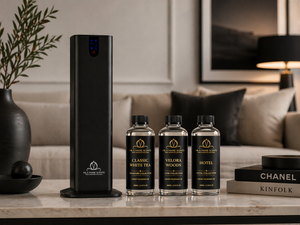
Which Diffuser Is Right for You?
| Feature | INFINITY | HALO Tower |
|---|---|---|
| Price | $399.00 | $229.00 |
| Coverage | Up to 16,000 sq ft | Up to 4,000 sq ft |
| Type | HVAC / Whole-Home | Floor Standing |
| App Control | Yes (Bluetooth) | Yes (Bluetooth) |
| Free Oils Included | Yes (3 Oils) | Yes (3 Oils) |
| Warranty | 1-Year | 1-Year |
| Guarantee | 30-Day | 30-Day |
Swipe to compare →
Get 10% Off Your First Order
Join the Mila Marie family for early access to new fragrances, exclusive offers, and expert scenting tips.